The Art of Reading Scribbles
Old German Handwriting — A Beautiful Nightmare
Some days in the office sound a bit like this:
"Is that an H or an S?" "Could this possibly say baker?" "No... wait... maybe butcher?"
Welcome to the world of old German handwriting.
A big part of our daily work involves reading historical records, church book entries, and handwritten documents that are often hundreds of years old. After many years of experience, we have become fairly good at decoding them, but every now and then a badly faded copy, smudged ink, or the particularly wild handwriting of a registrar from 1823 can still leave us completely puzzled. Even the most experienced genealogist has days where a single word takes twenty minutes to crack.
What Is Kurrent — and Why Is It So Hard to Read?
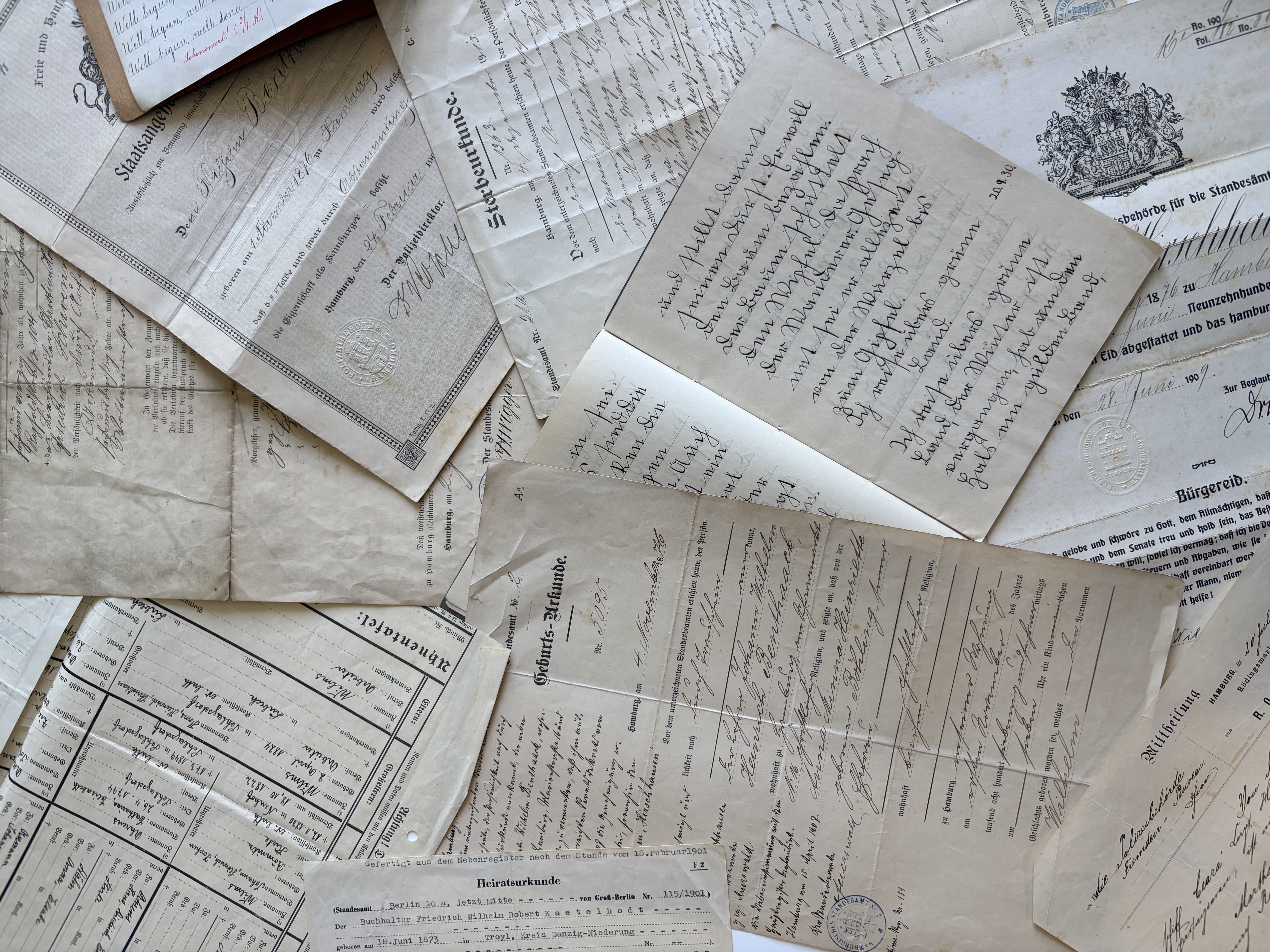
Unlike today, when most documents are typed neatly on computers, records in earlier centuries were written by hand with pen and ink. And not in simple block letters either! Most German records were written in a script called Kurrent, the standard handwriting style in German-speaking countries from the Early Modern period until the mid-20th century.
Kurrent is a connected, cursive script with letterforms that look almost nothing like the Latin alphabet most of us learned in school. The letters are angular, tightly spaced, and written with a distinctive pen pressure that creates thick downstrokes and thin upstrokes. An "n" can look like a "u." An "e" can practically disappear. And certain letters, the "h," "f," and "k" in particular, have a way of looking nearly identical to each other depending on the writer's hand.
Add to this the fact that every writer had their own style, and that spelling was far less standardized than it is today, and you begin to understand why even a short baptism entry can send a researcher down a thirty-minute rabbit hole.
Kurrent and Sütterlin: Not the Same Thing
Kurrent is often confused with Sütterlin, but the two are not the same. Sütterlin was developed in the early 20th century by Berlin graphic artist Ludwig Sütterlin, commissioned by the Prussian Ministry of Culture to create a simplified handwriting system that schoolchildren could learn more easily. It is rounder and more uniform than traditional Kurrent. Think of it as Kurrent's tidier younger sibling.
Sütterlin was introduced into Prussian schools around 1915 and spread gradually across Germany over the following decades. If you have ever come across a child's school exercise book from the 1920s or 1930s, like the one in the photograph accompanying this article, you are almost certainly looking at Sütterlin. Those careful, deliberate letterforms were the result of hours of practice, a ruler, and a great deal of patience.
Both scripts share the same basic DNA. Once you can read one, the other becomes considerably less intimidating.
The Day Everything Changed: 1941
In 1941, both Kurrent and Sütterlin were officially abolished and replaced by the "Deutsche Normalschrift," a Latin-based handwriting style that closely resembles the cursive writing taught in schools across the Western world today.
The reasoning given by the Nazi regime was blunt: the old German scripts were too difficult for the peoples of occupied territories to read. Hitler reportedly stated that the new style fit better into a "new age of steel and concrete." There was also a practical dimension to it. If you want people to read your words, they first need to be able to decipher them.
I have a small personal connection to this moment in history. My grandfather worked for the Deutsche Seewetterdienst, the German Maritime Weather Service, and had long been required to write in Latin letters when communicating with colleagues abroad. When the 1941 decree came into force, my mother's cousin was furious that she suddenly had to unlearn everything she had been taught and start again with a completely different script. It was my grandfather who explained, with quiet pragmatism, why the change had really happened and why he had seen it coming long before most people did.
It is the kind of story that only surfaces in family conversations. And it is exactly why personal testimonies matter just as much as official records.
Why This Still Matters for Genealogists Today
The shift to Deutsche Normalschrift in 1941 means that most records predating the mid-20th century, church books, civil registration records, military documents, emigration files, were written in either Kurrent or Sütterlin. If you are researching German ancestors, learning at least the basics of these scripts is not optional. It is essential.
The good news is that you do not need to become a paleography expert overnight. A few hours of focused practice with the alphabet, combined with the right reference tools, can take you from complete bewilderment to cautious confidence faster than you might expect. Common words in genealogical records, geboren (born), getauft (baptized), gestorben (died), verheiratet (married), begin to appear with reassuring regularity once your eye adjusts.
Context is also your friend. If you know you are looking at a baptism record from a Lutheran parish in Brandenburg in 1798, you already know roughly what information will appear and in what order. That alone can help you decode words you might never recognize in isolation.
A Few Practical Tips
Start with the alphabet. Printed Kurrent and Sütterlin alphabet charts are widely available online and make an excellent first reference. Pin one next to your screen when you work.
Look for anchor words. Find a word you can identify with certainty and use it to orient yourself in the rest of the entry. Names of places, months, and common relationship terms are good starting points.
Compare multiple entries. If one record stumps you, look at other entries by the same scribe. The same letters will reappear and patterns will emerge.
Do not commit too early. It is tempting to lock in a reading when you are only eighty percent sure. Write it down as tentative and keep checking.
And when all else fails, ask. The genealogical community is generous with its expertise, and there is no shame in a second pair of eyes.
Handwriting in the Age of Keyboards
Today, handwriting is slowly becoming a relic. Keyboards and digital communication have taken over, and most of us rarely write long texts by hand anymore. There is something a little sad about that, especially when you spend your days reading the carefully formed letters of people who took genuine pride in their penmanship.
So here is a small challenge: when was the last time you wrote a real letter with a pen?
And if you are feeling adventurous, why not try reading or even writing a few words in Kurrent yourself? There are good tutorials online, and it is a surprisingly satisfying skill to pick up.
One final request from everyone here who works with historical documents: if you ever write something intended for future generations, please, for the love of all genealogists yet to come, write legibly.
Struggling with Old Handwriting in Your Research?
If you are working with records on ARCHION and finding the Kurrent script a serious obstacle, there is good news. ARCHION now offers an AI-powered text recognition tool that can transcribe Kurrent script directly from the record images. Our ARCHION Research Guide, now in its third edition, includes a dedicated chapter on how to use this tool effectively and get the most out of it for your research.
👉 Get your copy here: https://germangenealogycollective.com/product-details/product/archion-research-guide
