Halloween in April? The Story of Walpurgisnacht and Your German Ancestors
If you're in Germany on April 30th, you might hear bonfires crackling, bells ringing, and people dancing well past midnight. No, your ancestors haven't come back to haunt you. It's Walpurgisnacht, and it's one of those wonderfully layered German traditions that makes you realize: the calendar your ancestors lived by looked very different from the one on your phone.
So who was Walburga, why does she have a whole night named after her, and what does any of this have to do with discovering your German ancestry? Pull up a chair. This one's good.
The Saint Behind the Night
St. Walburga (also spelled Walpurgis or Walpurgia) was an Anglo-Saxon abbess who came to what is now Germany as a Christian missionary. Her feast day was fixed in the church calendar on 1 May, commemorating the transfer of her relics to Eichstätt in the year 870. The night before, April 30th, became known as Walpurgisnacht - her eve.
For communities across German-speaking Central Europe, this was a legitimate liturgical date. It appeared in church calendars, was observed in parishes, and in regions like Franconia (Franken) and the areas around Eichstätt, St. Walburga's patronage ran deep. If your ancestors came from those areas, you may encounter her name in church dedications, parish histories, and feast-day references in local chronicles.
But Then the Witches Showed Up
Here's where it gets interesting - and a little more chaotic.
Long before Walburga's feast day was associated with May 1st, many communities across Central Europe were already marking the turn from winter to summer with fire festivals, noise-making, and seasonal rituals. Bonfires were lit to protect people, livestock, and crops. Bells were rung. Maypoles were raised. People danced.
When the Christian calendar landed on the same date, the two traditions merged into something gloriously complicated: a saint's feast night that also looked suspiciously like a spring folk festival.
And then Johann Wolfgang von Goethe published Faust - popularizing the now-iconic image of witches flying to the Brocken* (also called Blocksberg) for a nocturnal sabbath.
The idea of witches’ sabbaths, of course, had been circulating long before this in the late medieval and early modern periods, when fears of witchcraft helped drive waves of trials across Europe.
Today, the Harz region leans fully into this, with costume parties and staged folklore that draw tourists from across Germany. Your ancestors would probably find it amusing.
*The Brocken, at 1,141 meters (3,743 ft) the highest peak in Northern Germany, is locatedin the Harz mountain range near Wernigerode in the state of Saxony Anhalt.
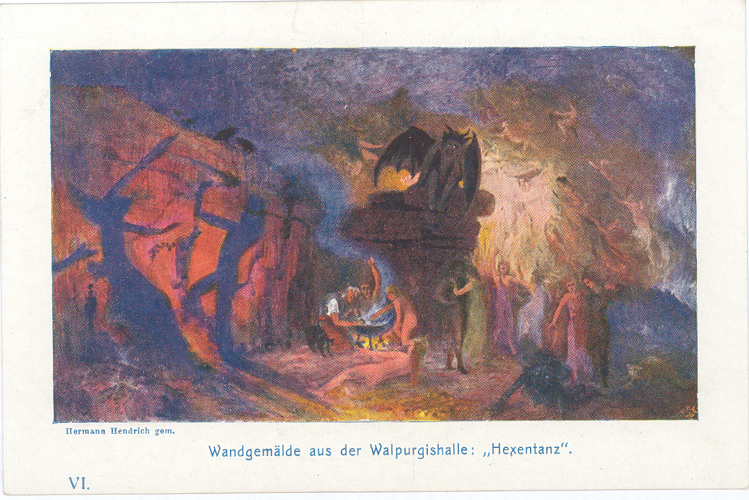
The witches' dance on Walpugisnacht by Hermann Hendrich (1854-1931).
Translation: Mural from the Walpurgis Hall: witches’ dance.
Who celebrated it?
Historically, the feast was observed by local communities in German-speaking Central Europe, especially in areas where church calendars, rural seasonal customs, and village life overlapped.
Today it is still celebrated in many parts of Germany, Austria, Sweden, Finland, the Czech Republic, and other European regions, though the form varies widely from village bonfires and civic events to tourist spectacles. In some Catholic settings, St. Walburga herself is still remembered liturgically on her feast days, especially in Eichstätt and related Walburga traditions.
The “witch night” version is now also a popular cultural event, especially in the Harz and other tourist areas, where costume parties and staged folklore attract visitors. So the people who partake today range from church communities and village associations to municipalities, families, young people, and heritage-tourism audiences.
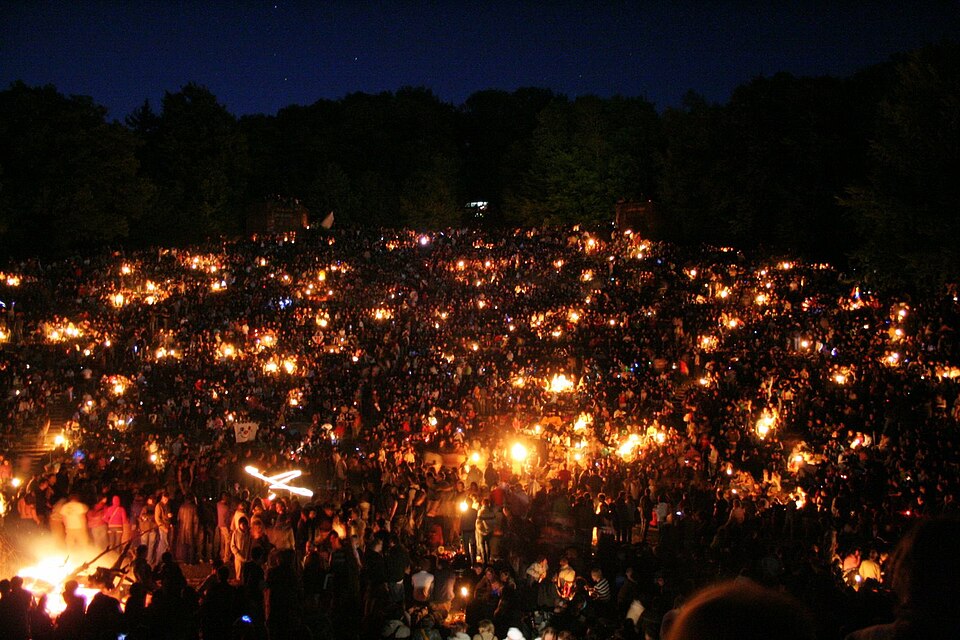
Image of the crowd on Walpurgis Night at the Thingstätte on the Heiligenberg in Heidelberg.
Photo taken by Andreas Fink: https://de.wikipedia.org/wiki/Datei:Thingst%C3%A4tte_Heidelberg_Walpurgisnacht_1.JPG
What This Means for Your Research
German ancestors didn't just live in family trees. They lived inside a rhythm of local life shaped by the church calendar, the farming cycle, and strong regional customs. Walpurgisnacht was part of that rhythm.
Here's what to look for:
Local chronicles and Heimat literature often reference communal festivals, processions, and seasonal customs alongside baptisms, marriages, and burials. Finding a Walpurgis fire or May procession mentioned in a village chronicle can anchor your ancestors more firmly inside their actual community.
Parish records from Franconia and Eichstätt-connected regions may reflect St. Walburga's significance through church dedications, feast references, or institutional history tied to her patronage.
Emigration and diaspora research: communities that emigrated often preserved seasonal customs long after the religious meaning faded. If a family maintained certain spring traditions in Pennsylvania, Minnesota, or Wisconsin, those practices can sometimes be traced back to a specific German village or region - a clue hiding in plain sight.
The Bigger Picture
Walpurgisnacht is a perfect example of something I often tell researchers: your ancestors were not living in a vacuum of names and dates. They were embedded in a world of saints' days, seasonal fires, communal celebrations, and local belief. Understanding that world doesn't just make the history richer - it makes the records make more sense.
Want to understand the records your German ancestors left behind -- and the world that shaped them? The German Genealogy Collective is the place to start.
Join us at https://germangenealogycollective.com/
